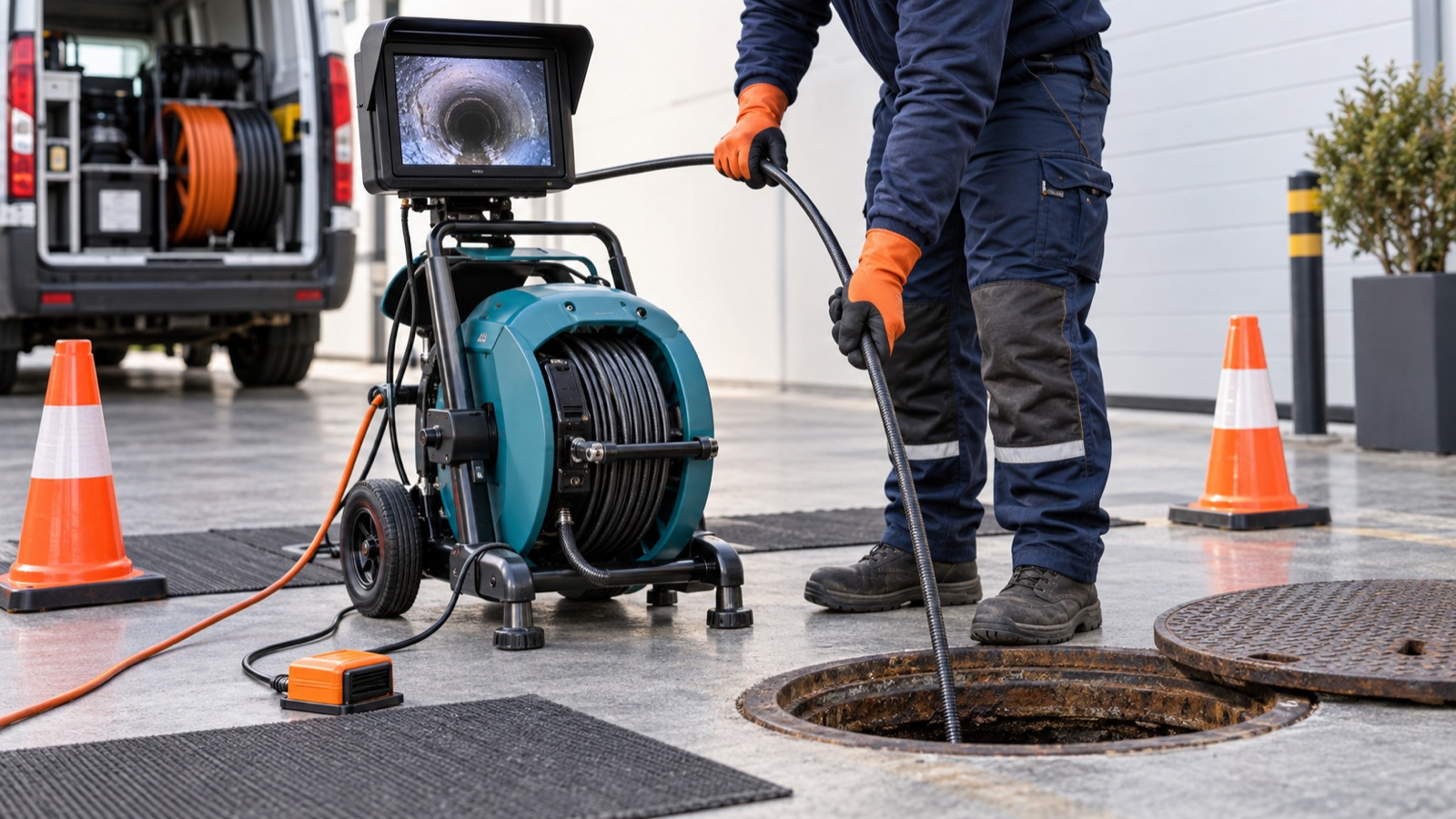
What “Picote” means in a drain-cleaning quotation
Picote is a manufacturer and product system, not a generic name for every form of drain cleaning. Its Miller range includes different machine and shaft sizes, with tools intended for particular pipe sizes and tasks. The official Picote Mini Miller specifications, for example, describe high-speed cleaning, descaling and root removal in a defined diameter range and list an operator-presence pedal, safety clutch and emergency stop among the machine's safety features.
A meaningful quotation should therefore say more than “use Picote.” Ask for:
- the symptom or recorded deposit being treated;
- the pipe material, approximate diameter and length in scope;
- the access point and any section that cannot be reached;
- the proposed Miller model and type of tool or tool family;
- whether cleaning, root cutting, liner removal, branch reinstatement or lining preparation is included;
- how debris, dust and wastewater will be controlled;
- what pre-clean and post-clean camera evidence will be supplied; and
- what happens if the survey exposes fragile or structurally damaged pipe.
The contractor remains responsible for choosing a compatible setup. A product name alone is not evidence that the method suits the pipe.
When Picote cleaning may be considered
| Finding or objective | How Picote equipment may fit | What must be confirmed first |
|---|---|---|
| Hardened mineral or uric scale has narrowed the bore | A suitable chain, brush or specialist tool may mechanically descale it | Pipe material, remaining wall condition, diameter and deposit hardness |
| Roots project through joints or defects | A compatible cutting tool may restore access or flow | Root size, pipe condition, exact entry points and a plan for the underlying defect |
| Concrete, grout or hard building deposit is recorded | Some Miller/tool combinations are intended for hard-material removal | Deposit extent, pipe material, safe tooling and risk of damaging the host pipe |
| A failed liner obstructs the pipe | Specialist tools may remove liner material or reopen a connection | Liner type, host pipe condition, access and reinstatement plan |
| A sound pipe needs preparation before lining or coating | Controlled cleaning may produce the required surface | The rehabilitation system's preparation specification and post-clean acceptance check |
| A soft, recent blockage simply needs flushing | Another method may be quicker and less intrusive | Whether water jetting or ordinary unblocking better matches the obstruction |
The manufacturer's Picote Miller selection guidance assigns different pipe-size and task ranges to different machines and warns against placing a larger-shaft tool on a smaller shaft. That is why material, diameter and intended task should appear in the scope before work begins.
For scale specifically, compare the proposed service with the broader drain-descaling guide. For roots, read about tree-root intrusion and professional root removal: cutting the root restores space but does not seal the defect through which it entered.
When another route or more diagnosis is needed
Picote cleaning should not be the automatic first response to every slow or blocked drain. Pause and reassess when:
- the obstruction has not been located or identified;
- the pipe may be collapsed, badly deformed, fractured or missing a section;
- the material, diameter or route is unknown;
- corrosive chemical cleaner may remain in the line;
- sewage is backing up and the immediate priority is containment;
- there is no safe access or no controlled way to remove debris;
- a simpler local blockage can be removed through a trap or ordinary unblocking; or
- the pipe is asbestos cement or its material cannot be confirmed.
Picote's own technical FAQ says high-speed cleaning tools are not recommended on asbestos-cement pipe. Because fragmenting or disturbing asbestos-containing material carries serious health and regulatory implications, stop if that material is known or suspected and seek appropriately licensed, location-specific advice.
A collapsed drain cannot be restored by cleaning. The pipe may need repair or excavation after its position and condition are established.
A well-scoped Picote cleaning process
1. Record the symptoms and previous work
Tell the contractor which fixtures are affected, when the problem began, whether it recurs, and where earlier tools stopped. Disclose every chemical, cleaner, root treatment, repair and lining product used, including when it was applied. The information to give a drainage engineer helps assemble a useful history.
Do not ask an operator to open or machine a line that may conceal corrosive liquid without warning. The service plan must account for the product label and safety data; see drain-cleaner safety.
2. Establish access and inspect the line
Where flow and access allow it, a pre-clean CCTV drain survey should record the route, approximate diameter, visible material, deposits, connections and defects. If the camera cannot pass a complete blockage, the report should state what was and was not seen rather than claiming that the whole pipe was assessed.
Agree the start and end points, the pipe length in scope, protection for the property, and how water, dust and removed material will be contained. The operator should also identify services or downstream areas that must not receive debris.
3. Match the machine and tool to the pipe
The selected shaft and tool must suit both the machine and the pipe. A tool for an intact plastic pipe is not automatically appropriate for a fragile or damaged pipe, and a root cutter is not automatically the right choice for mineral scale. Ask the operator to explain what the camera shows and why the proposed tooling is compatible.
The manufacturer's Miller operation and safety manual requires machine-specific preparation and operating controls. It also instructs operators to ventilate opened pipework and to use vacuum extraction or water to control dust during cleaning and cutting. Site conditions and the exact manual for the machine and accessory determine the actual controls.
4. Clean progressively and monitor the result
The operator should work in controlled passes rather than forcing the tool at an unexplained obstruction. Progress can be checked by retrieval of debris, camera views when practical, and changes in the usable bore. If the tool catches, the shaft overloads, the pipe condition changes or the observed material does not match the planned tool, work should pause for reassessment.
Restored flow is useful but incomplete evidence. A small channel through a deposit may carry water while leaving most of the restriction behind.
5. Inspect after cleaning
Ask for a post-clean camera run over the agreed length, with enough lighting and location information to compare it with the starting condition. It should show:
- the bore and pipe wall that are now visible;
- deposit or roots that remain;
- cracks, displaced joints, deformation or corrosion exposed by cleaning;
- connections that were reopened;
- the point where cleaning stopped and why; and
- any recommendation for repair, monitoring or further work.
Keep the original video, stills, written scope and invoice. If the cleaning was preparation for drain relining, the rehabilitation contractor should confirm that the host pipe and prepared surface meet that system's requirements before installation.
Picote drain cleaning versus other services
| Service | Main purpose | It does not establish by itself |
|---|---|---|
| Picote flexible-shaft cleaning | Mechanically remove selected hard deposits, roots or unwanted material with compatible tooling | That the pipe is structurally sound or repaired |
| High-pressure water jetting | Break and flush suitable deposits using selected water flow, pressure and nozzle | The nature and severity of a hidden structural defect |
| Conventional rodding or snaking | Open or retrieve a local obstruction with a manually or mechanically advanced tool | That coated pipe walls are fully clean |
| CCTV survey | Observe and record accessible internal pipe condition | Clear a blockage or make a repair |
| Relining, patching or excavation | Repair an evidenced defect using a method suited to its location and condition | That preparatory cleaning has been completed correctly |
These methods can be complementary. A contractor might restore camera access, inspect the pipe, use Picote equipment on a compatible hard deposit, remove the debris, and then inspect again. That sequence should be justified by evidence, not sold as a compulsory package.
Picote drain cleaning cost: what changes the quotation?
There is no responsible universal price for Picote drain cleaning. The work can range from one accessible section with a known deposit to a long or complex run requiring several tools, containment and repeated inspection. Location, tax and call-out terms also differ. A quotation is more useful when its assumptions are written down.
| Cost factor | Why it changes the work | What to ask for |
|---|---|---|
| Survey and diagnosis | The deposit and pipe may need to be identified before tooling can be selected | Is pre-clean CCTV included, and what happens if the camera cannot pass? |
| Access | Traps, cleanouts, chambers and vertical or restricted locations require different setup | Which access point is included, and is creating access extra? |
| Pipe dimensions and length | Machine, shaft, tooling and time depend on diameter and distance | What diameter and measured length does the quote assume? |
| Pipe material and condition | Fragile or damaged pipe may require a different tool, slower work or another method | What evidence supports the proposed setup? |
| Deposit type and severity | Light scale, roots, concrete and failed liner call for different passes and consumables | Which material is included and which findings trigger a revised scope? |
| Debris, water and dust control | Safe collection and disposal may require extraction, flushing, protection and cleanup | Are containment, cleanup and lawful disposal included? |
| Verification | Camera footage and a written result take equipment and operator time | Are before-and-after video, stills and a report included? |
| Timing and site constraints | Emergency, out-of-hours, commercial or difficult-access work can change labour and setup | Are call-out, travel, parking, permits and out-of-hours terms itemised? |
| Follow-on work | Root entry, damaged pipe or lining preparation may lead to separate services | Is any repair, reinstatement or lining included, optional or excluded? |
Ask whether the quote is fixed for the stated scope, hourly, per pass, per metre or subject to findings. Confirm applicable tax, minimum charge, cancellation terms and the approval required before extras begin. Do not compare totals until the competing quotes include the same pipe length, tooling, debris handling and verification.
The manufacturer's public pricing answer directs equipment buyers to regional resellers rather than publishing a single machine price. That reinforces the need for a job-specific service quotation; equipment purchase price is not the same as the cost of competent site work.
Safety and escalation boundaries
Do not operate borrowed or hired high-speed flexible-shaft equipment as a casual DIY extension of a hand snake. The manufacturer's manual describes serious rotating, electrical, dust and noise hazards as well as machine-specific controls. Training on one drain-cleaning method does not establish competence on every Miller, accessory, material or site.
Stop or postpone the service when:
- the operator cannot identify the machine/tool compatibility or produce the relevant instructions;
- access would require entering a manhole or other confined space without a compliant work plan;
- pipe gas, dust, wastewater or chemical exposure cannot be controlled;
- the pipe may contain asbestos cement;
- inspection indicates collapse or damage that cleaning may worsen;
- the shaft or tooling cannot be advanced or retrieved under control; or
- wastewater is escaping into occupied space, public ground or a watercourse.
Sewage can contain disease-causing organisms. The US Centers for Disease Control and Prevention recommends waterproof gloves, splash protection where required, covered cuts and thorough hand hygiene in its guidance for people handling human waste. The contractor's risk assessment must also address local electrical, machinery, noise, waste and confined-space requirements.
Questions to ask a Picote contractor
- What did the initial inspection identify, and which sections remain unseen?
- Which Picote machine and tool will be used, and why do they suit this pipe?
- Is the objective unblocking, descaling, root cutting, liner removal or surface preparation?
- What could make the work stop or change price?
- How will dust, wastewater and removed debris be controlled and disposed of?
- What damage risk remains, and what happens if a weak pipe is uncovered?
- Will I receive complete before-and-after footage and a written account of the length treated?
- Is any branch reinstatement, repeat pass, repair or lining included?
- What training, insurance and warranty cover the work and any resulting damage?
Bottom line
Picote drain cleaning can be a useful professional option for compatible hard deposits, roots, unwanted material and rehabilitation preparation. Its value depends on diagnosis, correct machine and tool selection, controlled operation, debris management and post-clean evidence. Compare quotations by their written scope and cost factors—not by an unsupported headline price—and remember that cleaning restores access or bore; it does not repair a defective pipe.
Sources and further reading
Tell the engineer about every chemical or home treatment already used. Hidden corrosive liquid can put people at risk when a pipe or trap is opened.