Warning signs—and what they do not prove
| What you notice | What it may mean | Sensible next check |
|---|---|---|
| One fixture drains slowly | A local trap or branch blockage is more likely | Check the stopper, trap and nearby branch first |
| Several fixtures back up together | A restriction may be farther along the shared run | Stop using connected fixtures and arrange diagnosis |
| The same blockage returns in the same place | Deposits, roots, a displaced joint or structural damage may be trapping debris | Survey the cleaned pipe rather than repeating the same clearance |
| A rod or cable meets hard resistance at a repeatable distance | A bend, junction, obstruction or defect may be present | Do not force the tool; record the distance and inspect |
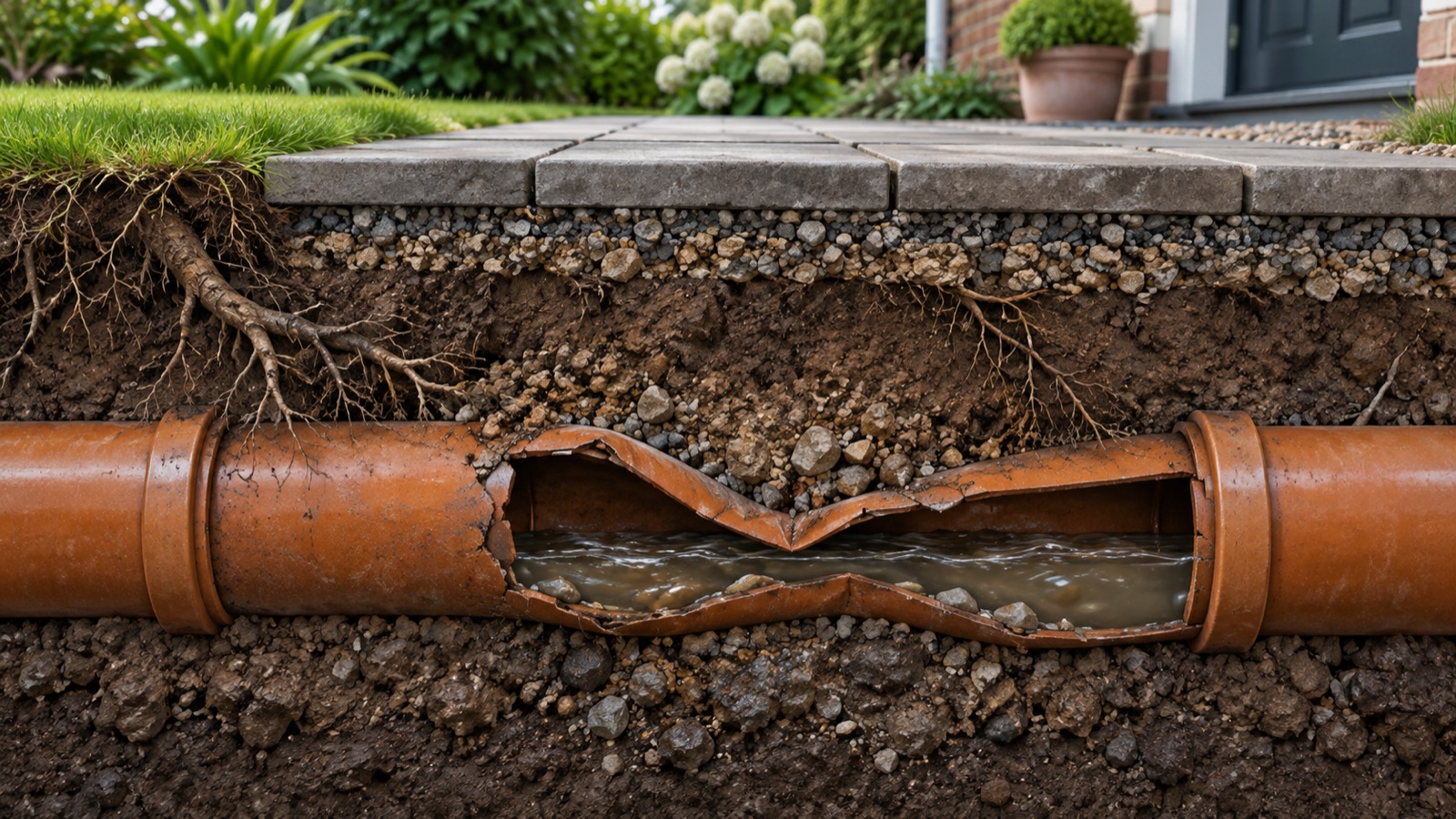
| A camera shows deformation, a break, a hole or missing pipe wall | Structural damage is possible | Have the complete footage and pipe condition assessed |
No single symptom can distinguish a collapsed pipe from a severe blockage, root intrusion or displaced joint. Treat a diagnosis made from sound, smell or resistance alone as provisional.
First actions when wastewater is backing up
- Stop running taps, appliances and toilets that discharge into the affected line. More water can turn a restriction into an overflow.
- Keep people and pets away from sewage or contaminated standing water.
- Check whether one fixture, several fixtures or neighbouring properties are affected. This helps locate the problem but does not prove its cause.
- Note when the problem began, earlier clearances and the approximate point at which tools meet resistance.
- If the blockage is not plainly local and safely accessible, arrange a professional drain inspection.
Responsibilities vary with the pipe's location, who it serves and the local system. In England and Wales, a drain serving only one property within its boundary is commonly the owner's responsibility, while a lateral drain or pipe serving more than one property is commonly the sewerage company's responsibility. Check the current rules and your local provider before ordering work; West Northamptonshire Council's overview illustrates this distinction.
What a useful CCTV drain survey should show
A useful survey is more than one dramatic still image. Ask for:
- The property, date, contractor and exact access point.
- A continuous, well-lit run through the relevant pipe, with the direction of travel stated.
- A distance counter and a surface location for important observations where locating equipment is available.
- The pipe size, material, changes of direction and connections that can be identified reliably.
- The position and extent of deformation, fractures, holes, displaced joints, roots, deposits and standing water.
- The end point reached, any section that could not be inspected and the return journey.
- The original video, useful stills, a plan or sketch and a written report.
The City of Portland's sewer-video requirements are a useful example of why identification, entry point, complete coverage, lighting, narration, distance and mapping matter. Your local reporting standard may differ.
In North America, the NASSCO Pipeline Assessment Certification Program separates structural findings from operation-and-maintenance findings. Its condition-grading explanation also cautions that severity and the number of occurrences both matter. A grade or isolated screenshot is not, by itself, a complete risk assessment or repair specification.
Blockage, displaced joint or collapse?
A removable blockage occupies an otherwise serviceable pipe. Proper clearance should restore an open bore, although grease, scale or roots may recur if the underlying cause remains.
A displaced or open joint occurs where connected pipe sections are no longer aligned or sealed as intended. The pipe may remain partly open, but the step or gap can catch debris, admit roots or allow surrounding material to enter.
A collapse is a more serious loss of pipe shape or continuity. The camera may be unable to pass it, but inability to pass can also result from a tight bend, debris or unsuitable equipment. The surveyor should explain the visual evidence rather than infer a collapse solely from a stopped camera.
Repair choices after the diagnosis
| Possible route | When it may be considered | What must be checked first |
|---|---|---|
| Local patch repair | A short, accessible defect in pipe that can support a patch | Pipe material, preparation, defect geometry and remaining structural support |
| Full or sectional lining | The route can be cleaned and a liner can pass through a pipe that retains a suitable shape | Diameter, deformation, connections, host-pipe condition and cure/access requirements |
| Excavation and replacement | The pipe has lost continuity or shape, the route cannot be prepared, or access to reconnect it is required | Exact location/depth, other utilities, ground conditions, permissions and reinstatement |
| Monitor or maintain | The finding is minor and a competent assessment does not justify immediate repair | Baseline footage, consequence of failure and a review interval |
These are categories, not a remote diagnosis. A contractor should show how the recommended method addresses the recorded defect and why less disruptive options are or are not suitable. See the site's guides to patch repairs, drain relining and drain excavation before comparing quotes.
Questions to ask before approving work
- Can I have the complete pre-clean and post-clean video, not only selected stills?
- Where is the defect, how was it located and what part of the pipe was not visible?
- Is the finding structural, an obstruction, or both?
- What preparation is required before the proposed repair?
- How will connections remain open and how will the result be verified?
- What assumptions could change the quotation after work begins?
- Who is responsible for this section of pipe, and are permissions or insurer approval required?
- What guarantee covers workmanship and what does it exclude?
Can you unblock a collapsed drain yourself?
You may be able to remove loose debris from an accessible line, but you cannot repair a collapsed pipe with drain cleaner, a plunger, rods or a snake. Forcing a tool at hard, repeatable resistance can trap equipment or worsen damage. Stop if sewage is backing up, a tool is stuck, the pipe may be structurally damaged, or the route is not understood. The DIY stop guide sets out the wider escalation signs.
Bottom line
Treat “collapsed drain” as a diagnosis that must be evidenced, not a label for every stubborn blockage. Control the immediate backup, document the symptoms, obtain complete CCTV evidence and compare repair choices against the actual location and extent of damage.
A symptom cannot confirm the pipe condition on its own. Stop DIY work if the route is unknown, tools jam, wastewater backs up or the blockage returns.