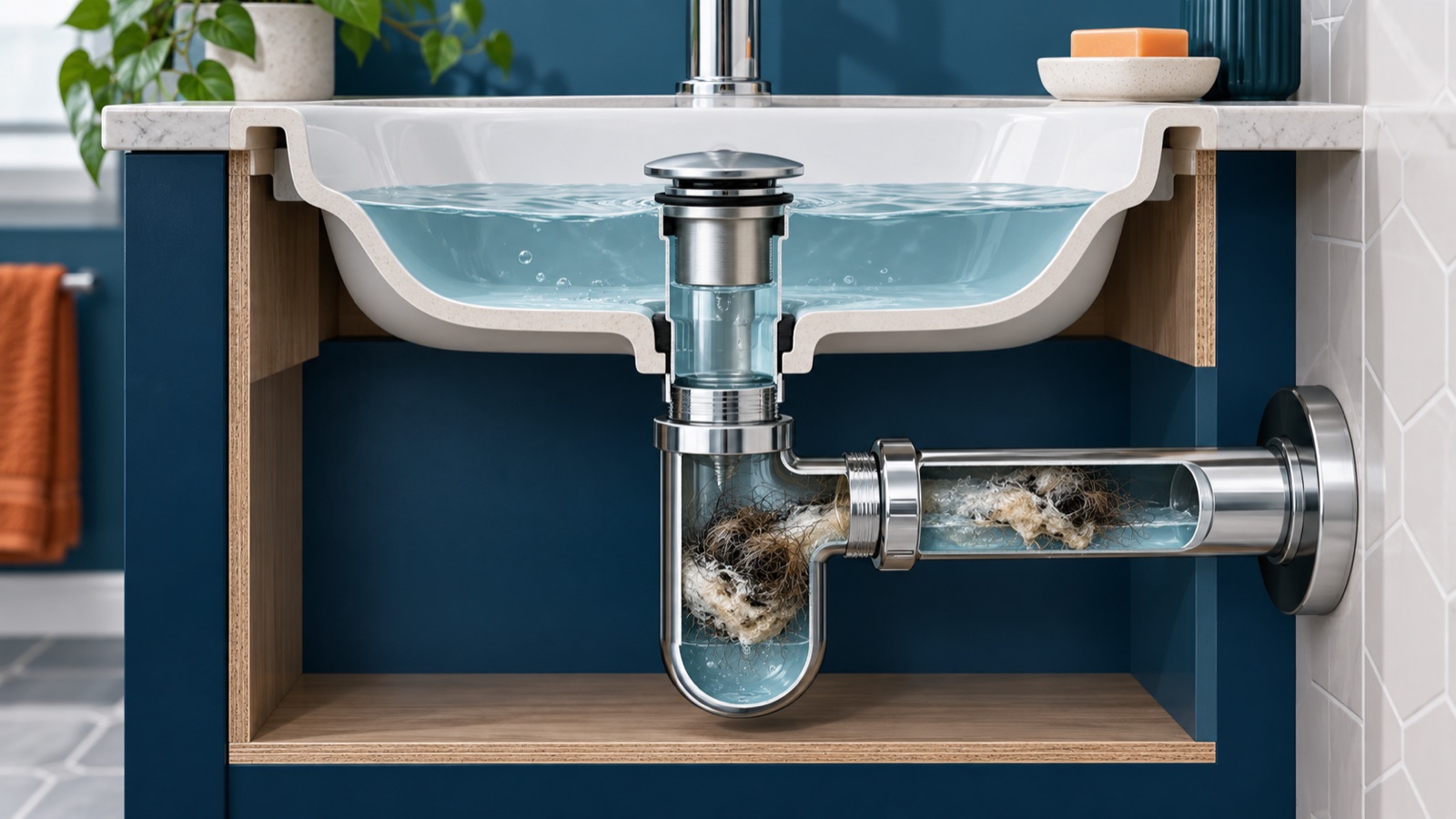
Work out how far the blockage is likely to be
| Symptom | More likely location | First useful check |
|---|---|---|
| Water pools around a closed or slow stopper | Stopper and drain opening | Remove and clean the stopper if the design allows |
| Basin drains slowly but nearby fixtures are normal | Trap or local branch | Plunge, then inspect the trap |
| Basin remains blocked with the trap removed and clear | Pipe beyond the trap | Use an appropriate small hand snake or call a plumber |
| Basin gurgles when another fixture drains | Shared branch or venting may be involved | Stop treating it as a stopper-only problem |
| Several fixtures back up together | A restriction may be farther downstream | Limit water use and arrange diagnosis |
These are clues, not guarantees. A single slow fixture does not prove that the trap is blocked, and several affected fixtures do not reveal the exact cause.
Before you touch the drain
- Do not mix drain cleaners, bleach, acids, ammonia or other cleaning products.
- If a chemical opener is already in the basin or trap, do not plunge or open the trap unless the label explicitly tells you how to proceed. Splashing trapped corrosive liquid can cause serious injury. Read the drain-cleaner safety guide.
- Keep children and pets away. Protect the cabinet and floor, wear suitable gloves and eye protection, and have a shallow container and towels ready.
- Do not disassemble a trap you cannot reach safely, a corroded fitting, or pipework connected to an appliance that has not been isolated.
The CDC warns never to mix household bleach with other cleaners because dangerous vapours may be released. Product labels and safety data take priority over a generic DIY sequence.
Step 1: clear the stopper and drain opening
Remove visible hair and residue without pushing it deeper. Depending on the basin, the stopper may lift out, unscrew or connect to a pivot rod behind the tailpiece. Photograph the arrangement before releasing anything and keep small parts in order.
Clean the stopper, the opening and the short section you can reach with a purpose-made hair tool. Do not use a sharp object that can puncture a flexible connector or scratch the basin. Refit the stopper and test with a small amount of water.
How to unblock a bathroom sink safely
If hair is wrapped around the stopper or visible at the opening, remove it with a purpose-made retrieval tool before applying pressure. The dedicated guide to removing hair from a drain explains which material is reachable and when to stop.
If the opening is clear and only this basin drains slowly, a flat-cup plunger is a reasonable next test when no drain cleaner may be present and the joints below are sound. The overflow must be sealed for pressure to reach the restriction. Use the dedicated sink-plunging instructions for the complete technique, stop conditions and leak check; do not repeat the procedure indefinitely if it produces no change.
If plunging changes nothing and a serviceable bottle trap or P-trap is the likely location, inspect it only when it is accessible, stable and free of chemical cleaner. Some traps are glued, concealed or integral and should not be forced. The bottle-trap cleaning guide owns the full removal, washer positioning, reassembly and staged leak-test procedure.
If the trap is confirmed clear but water still will not pass, the restriction may be in the branch pipe. A correctly sized hand snake may be appropriate, but a hard stop can be a fitting, solid object or damaged pipe rather than a soft clog. Read how to use a drain snake before selecting or inserting a cable. This diagnosis page does not replace the tool's manual or the dedicated method guides.
When the blockage is probably not local
Check other fixtures before reassembling the cabinet and declaring the job finished. If a bath, shower, floor drain or toilet changes level or gurgles when the basin runs, the shared line may need attention. Neighbours with the same problem can also indicate an issue outside a single private branch.
In the UK, responsibility depends on whether a pipe serves one property, lies beyond the boundary or forms part of a shared/public sewer. The Southampton City Council blockage guide is one official example; check your local water company because arrangements and contacts differ. In other countries, contact the relevant local utility or municipality.
Arrange a professional drain-unblocking assessment when:
- Multiple fixtures are slow or backing up.
- The blockage returns soon after the trap and branch are cleared.
- A snake cannot be advanced or retrieved under control.
- A joint leaks, pipework is corroded, or the cabinet installation is strained.
- Sewage rather than basin water is returning.
- You cannot establish what chemical is in the line.
Prevent another blocked wash basin
- Remove hair from the stopper regularly rather than washing it through.
- Keep cosmetics, dental floss, wipes, cotton buds and solid soap fragments out of the drain.
- Clean a serviceable trap when symptoms first recur, not only after flow stops.
- Repair a dripping or misaligned joint rather than tightening it repeatedly.
- Treat a recurring blockage as a location or pipe-condition problem that needs diagnosis.
Bottom line
For a blocked bathroom sink or wash basin, start shallow and progress only when the previous step is clear: stopper, sealed plunging, trap, then a controlled hand snake. Stop when the symptoms involve other fixtures, chemicals, leakage or hard resistance. Those signs make diagnosis more valuable than a stronger DIY method.
Do not combine chemical products or use a plunger, snake or rod in liquid that may contain a corrosive cleaner.