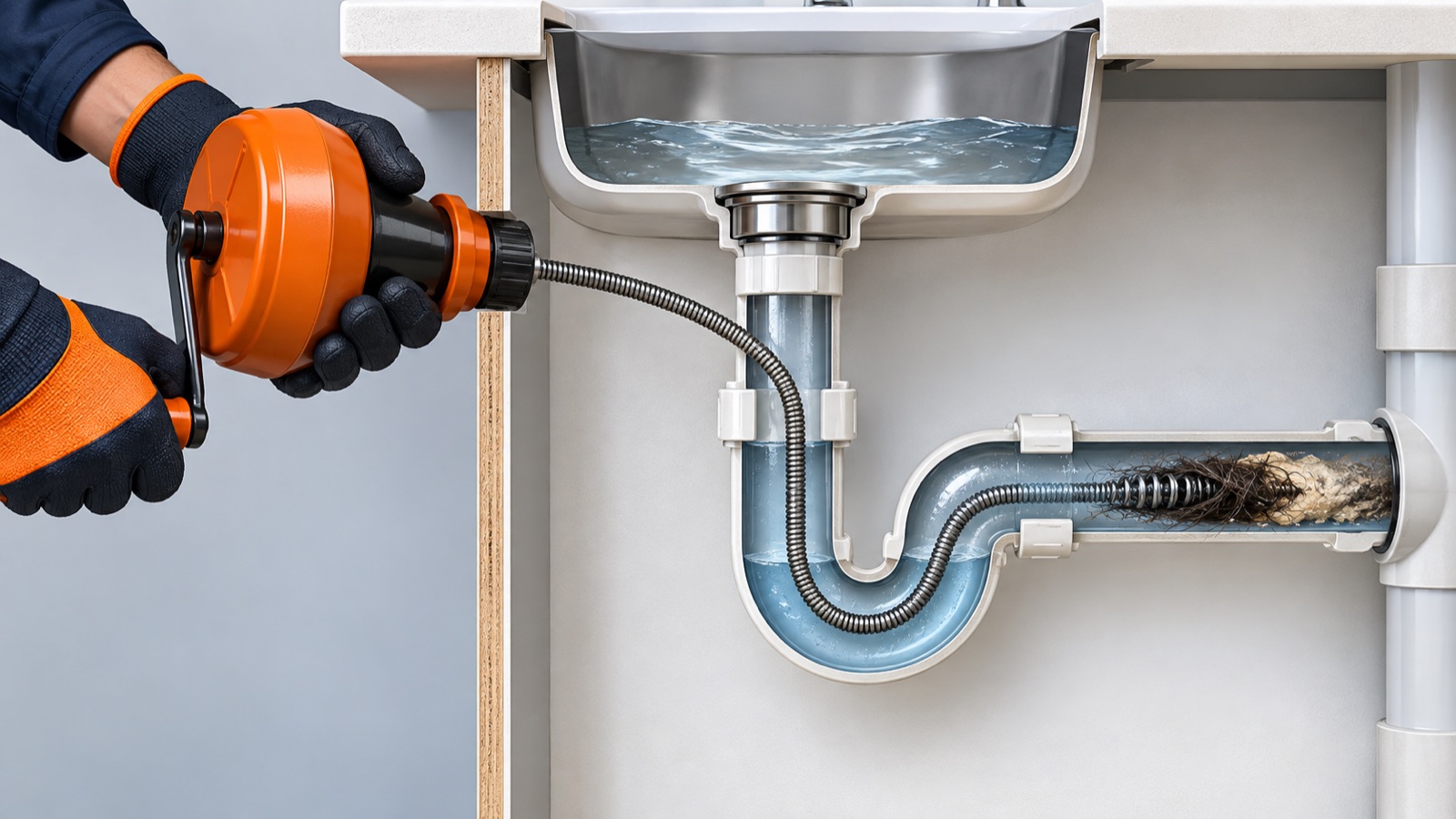
Before you start: make sure a snake is the right tool
A hand drain snake is a reasonable next step when one sink, bath or shower drains slowly and a visible strainer or trap blockage has already been ruled out. If the problem is directly beneath a sink, cleaning the sink trap may be quicker and gives better access to the branch pipe.
Choose a different route when:
- several fixtures are slow, gurgling or backing up, which can indicate a shared branch or main-drain problem;
- wastewater is rising through another fixture or there is sewage on the floor;
- a hard object, glass or jewellery is known to be in the drain;
- the pipe is visibly damaged, badly corroded or has fragile joints;
- the only access would put an unprotected cable through a toilet—use a purpose-made toilet auger instead;
- chemical drain cleaner is still in the pipe; or
- the job requires a powered drain-cleaning machine, roof access, a manhole or work on a main sewer.
If more than one drain is affected, use the multiple blocked drains checklist before opening any pipework.
Chemical warning: Do not put a snake into a drain that may contain caustic, acidic or otherwise hazardous cleaner. The cable can splash trapped liquid onto skin and eyes. Do not add another product to “neutralise” it. Follow the product label and the guidance on what to do after drain cleaner fails, or tell a drainage professional exactly what was used and when. Poison Control explains that many non-enzymatic drain cleaners are highly corrosive and can cause serious burns in its drain-cleaner safety guidance.
Pick the correct tool and access point
“Drain snake” is used for several different tools. They are not interchangeable.
| Tool | Suitable use | Important limit |
|---|---|---|
| Plastic barbed hair tool | Hair close to a basin, bath or shower opening | Too short for a deeper branch blockage |
| Hand drum or canister snake | Small household fixture drains within the tool’s stated pipe-size and cable limits | Can kink if too much cable is exposed or force is used |
| Toilet auger | A toilet trapway | Its protective guide helps avoid scratching porcelain |
| Powered drum or sectional machine | Longer, larger or difficult drain runs | Requires the exact machine, cable, PPE and training specified by the manufacturer; it is outside this DIY guide |
Check the snake’s manual for compatible pipe diameters, cable length, permitted direction of rotation and required gloves. A cable that is too large may not pass a tight bend; one that is too small can fold or kink in a larger pipe.
For a shower or bath, the drain opening may provide a straight enough route once the removable cover is taken off. For a sink, a removable trap often provides a better route into the wall branch than trying to force a cable through the strainer and tight trap bends. Never dismantle a trap if hazardous cleaner may be inside it.
What you will need
- a hand-operated snake suited to the fixture and pipe;
- eye protection and only the close-fitting glove system specified by the snake manufacturer for that exact tool and cable;
- old towels and a bucket;
- a screwdriver or trap tools only if the access fitting requires them;
- a refuse bag for retrieved debris; and
- good lighting and ventilation.
Drain contents can contain harmful microorganisms, but biological protection and rotating-cable protection are not interchangeable. Follow the snake manual: never wear loose gloves or hold a rag against a moving cable. For cleanup after the cable is fully stopped, avoid touching your face, cover cuts with waterproof dressings and use contamination protection appropriate to the task. The US Centers for Disease Control and Prevention recommends waterproof gloves, splash protection where needed and careful hand hygiene for work involving sewage in its guidance for people handling human waste.
How to use a hand drain snake step by step
1. Confirm that the blockage is local
Run a small amount of water in nearby fixtures. If only one fixture is slow and there is no backup elsewhere, a local branch blockage is plausible. Stop the test immediately if water rises in another fixture.
Remove hair or debris that is visible at the opening. A snake should not be the first tool used on an obstruction you can lift out safely.
2. Prepare the work area
Stop anyone using the fixture. Isolate any dishwasher or washing-machine hose that discharges into the same sink waste so the appliance cannot pump water into the open pipe. Put towels and a bucket below removable fittings.
Inspect the snake before use. Do not use a cable that is flattened, badly corroded, kinked or separating. Read the tool instructions even if you have used a different snake before; cable controls and rotation rules vary.
3. Open the safest access point
Remove only the cover, stopper or trap needed to create a controlled route. Photograph washer and seal positions before dismantling a trap. If a fitting is glued, seized, heavily corroded or begins to deform, stop rather than breaking it.
Place the cable tip just inside the pipe before uncoiling more cable. This prevents the free end whipping around.
4. Feed the cable gradually
Push the cable forward by hand in short increments. Keep only a short, controllable length between the drain opening and the snake housing. If the tool has a cable lock, lock only the amount you can control, then rotate the drum or handle exactly as its instructions direct while applying light forward pressure.
Do not use body weight or a power drill to force a manual snake. If the cable bows, loops or begins to twist outside the drain, stop, release the tension and retract it.
5. Tell a bend from the blockage
A pipe bend often feels firm at first and then allows the cable to advance when you ease back, change the cable angle and rotate gently. A soft blockage may feel springy or spongy and may let the cable advance in small stages. A sudden immovable stop can be a fitting, a solid object or damaged pipe.
When you meet resistance:
- Stop pushing.
- Retract the cable a few centimetres.
- Rotate and advance gently again.
- Repeat in short passes rather than forcing one long push.
If the same hard stop remains, or the cable repeatedly returns kinked, end the attempt.
6. Work and retrieve the obstruction
Once the cable passes into or through a soft obstruction, move it a short distance backwards and forwards while maintaining controlled rotation. The aim is to loosen material and, where possible, bring it back—not simply push it farther down the line.
Stop rotation and release cable tension before your hands or a cloth approach the exposed cable. Withdraw it slowly only as the tool's instructions direct. If wiping is permitted, do so only while the cable is fully stopped; never wrap or hold a cloth around a moving cable. Place hair and solid debris in the bin, not back into the drain.
If the first pass retrieves material, make one further controlled pass. Repeated passes with no improvement suggest the obstruction is beyond the tool’s useful range or is not a soft clog.
7. Reassemble and test
Clean sealing faces, refit the cover or trap with its washers in their original positions, and hand-tighten removable plastic fittings. Wipe every joint dry.
Test in stages:
- Run a small stream for 15–30 seconds while watching the joints.
- Increase the flow only if the water clears and there is no leak.
- For a sink, partly fill the bowl and release it while checking below with dry tissue.
- Check the fixture again several minutes later for slow seepage.
A successful result is free drainage under a normal flow, no gurgling or backup in another fixture, and dry joints after the test.
Troubleshooting while using a drain snake
| What happens | Likely explanation | What to do |
|---|---|---|
| Cable will not pass the first bend | Poor access angle, cable too large, or tight trap | Retract it; use a straighter access point or the correct smaller hand tool |
| Cable coils outside the drain | Too much cable is exposed or the tip is stuck | Stop rotating, relieve tension and retract; do not grab a moving cable |
| Cable advances but the drain stays slow | It made a small hole, missed the blockage or the restriction is farther away | Retrieve debris, make one controlled second pass, then reassess |
| Cable returns clean at the same hard stop | Solid object, fitting, scale or damaged pipe | Stop; forcing it risks a stuck cable or pipe damage |
| Drain improves and quickly blocks again | Material remains, or there is a structural/gradient problem | Arrange an inspection; see recurring drain blockages |
When to stop and call a professional
Stop if the cable kinks, binds or cannot be retrieved; a fitting leaks or shifts; sewage appears; another fixture backs up; you suspect roots, concrete, collapse or a displaced joint; or two careful passes make no meaningful improvement. A professional can choose a cable and cutter for the pipe, control a powered machine and use a CCTV drain survey when the symptom suggests more than a local soft blockage.
Never convert a hand snake into a powered tool unless the manufacturer specifically designed and supplied it for that use. Powered cables can twist, break and whip. RIDGID’s official drain-cleaning literature and operator manuals illustrate why machine-specific setup, gloves and cable control matter.
Aftercare
Clean, dry and store the snake exactly as its manufacturer directs. A wet or chemically contaminated cable can corrode and weaken. Disinfect the work area with a product suitable for the surface, following its label; never mix cleaning products. Wash your hands with soap and water after the equipment and gloves have been put away.
To reduce another blockage, remove hair before it enters the drain, keep fats and food scraps out of sinks, and address a drain that repeatedly slows rather than relying on increasingly aggressive tools.
Sources and further reading
Powered or long cables can injure hands and damage pipework. Use professional equipment only with appropriate training.