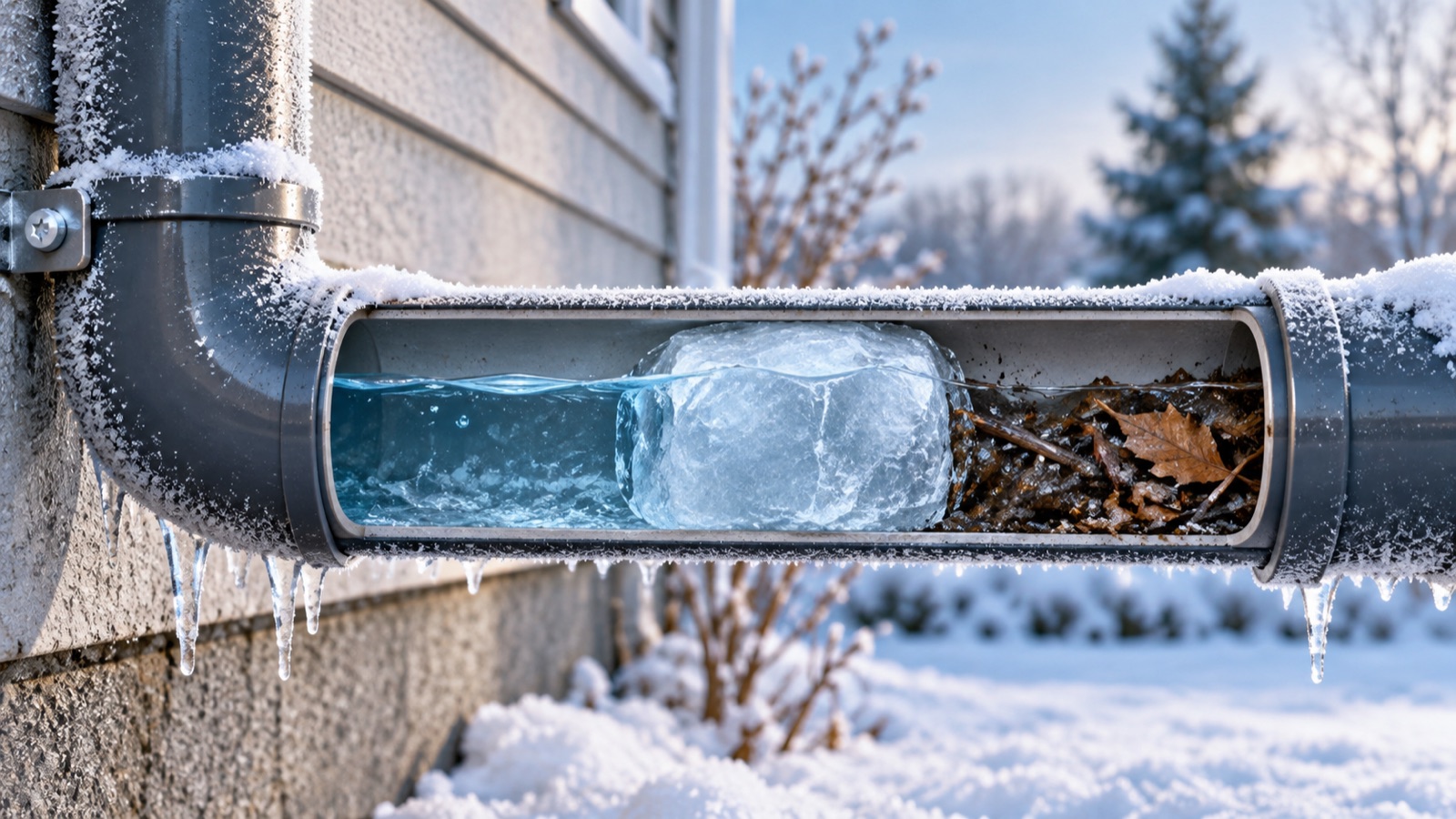
First, identify which kind of pipe is frozen
People often use “frozen pipe” for three different faults:
- Water-supply pipe: little or no fresh water comes from a tap. Closing the building’s stop valve may be necessary because a split can leak as the pipe thaws.
- Waste or drain pipe: water reaches the fixture but will not drain away. Adding more water can make the basin, bath or toilet overflow.
- Boiler condensate pipe: a condensing boiler stops and displays a fault during freezing weather. Follow the boiler manufacturer’s instructions or use a suitably qualified heating engineer; do not dismantle boiler components.
This guide is about an accessible household waste pipe. For a suspected frozen supply pipe, follow local water-provider advice. Northern Ireland's official frozen- and burst-pipe guidance covers isolating a water supply, slow thawing and avoiding naked flames.
Frozen drain or ordinary clog?
A waste pipe does not normally contain a full bore of stationary water. Freezing is more likely where water is already trapped by a sagging run, poor fall, partial blockage or an exposed low point. Finding and correcting that underlying fault matters, or the drain may freeze again.
| Sign | More consistent with freezing | More consistent with a clog |
|---|---|---|
| Timing | Began during or just after sustained sub-zero weather | Developed independently of temperature, often gradually |
| Location | Exposed pipe, unheated void, outside wall, gully connection or known low spot | Trap, fixture branch or a line that regularly collects hair, grease or debris |
| Visible evidence | Frost, ice at an outlet, or one section markedly colder than the rest | Debris at the opening, a history of slow drainage or a repeat blockage |
| Response to warmer weather | Improves as the pipe warms | Usually remains slow or blocked |
| Fixtures affected | Fixtures sharing the exposed frozen run | One fixture for a local clog; several fixtures for a larger drainage fault |
These are clues, not proof. A blockage can coincide with cold weather, and frozen wastewater can conceal a physical obstruction. If you cannot trace the route and identify the accessible frozen section without opening a wall or entering a confined space, stop.
Immediate actions
- Stop using the affected fixture. Do not repeatedly flush a toilet or pour water into a sink, bath or outside drain that cannot discharge.
- Warn everyone in the property. Isolate any dishwasher or washing machine that pumps into the affected waste branch.
- Check for overflow and leaks. Keep people and pets away from wastewater. If water has reached electrics, do not touch wet equipment or stand in water; isolate power only if you can do so safely and obtain urgent professional help.
- Check other fixtures. If several are backing up, use the multiple blocked drains checklist. That pattern can indicate a shared blockage rather than a short frozen section.
- Inspect only from a safe position. Do not enter a manhole, crawl into a restricted void or work from an icy ladder.
Aberdeenshire Council’s advice on frozen waste pipes specifically warns against adding water when an outside drain is frozen because it can return and overflow.
When a DIY thaw is reasonable
Only consider the steps below when all of these are true:
- the affected pipe is a waste pipe, not an unknown service;
- the frozen area is visible, reachable from ground level and safely accessible;
- the pipe has no visible split, displaced joint, bulge or active leak;
- there is no sewage backup or hazardous chemical in the line;
- the area is dry enough to use the chosen warming method safely; and
- you can stop all fixtures and appliances discharging into the pipe.
If any point is uncertain, use a plumber or drainage professional. A hidden leak can begin only after the ice releases, so prepare to stop the water sources and contain leakage even when the pipe initially looks sound.
How to thaw an accessible frozen waste pipe
1. Trace the route and protect the area
Follow the visible waste pipe from the fixture towards its outlet, looking for exposed bends, shallow falls and low points. Move possessions away and place towels or a container beneath joints that could leak. Clear snow and ice from your standing area without striking the pipe.
Do not detach a frozen fitting. Cold plastic can be brittle, and ice may be holding wastewater behind the joint.
2. Apply gentle external warmth
Use a hot-water bottle wrapped in cloth or towels soaked in warm—not boiling—water. Replace or re-warm them as they cool. If the surroundings are dry and the pipe material and manufacturer allow it, a handheld hairdryer on a low or medium setting can be kept moving at a safe distance. Keep the appliance, plug and cable away from water and never leave it unattended.
Warm the accessible frozen area gradually rather than concentrating high heat on one point. Stop immediately if the pipe deforms, a joint moves, water begins leaking or electrical conditions become unsafe.
NI Direct and the American Red Cross both advise slow warming and warn against naked flames; see NI Direct's thawing advice and the Red Cross guide to preventing and thawing frozen pipes.
3. Give meltwater somewhere safe to go
Do not pour more water down the affected fixture while the pipe remains blocked. For an external section, continue gentle warming until visible ice clears and any retained wastewater can move towards a known open discharge route. Never assume an underground section is clear merely because the exposed section has warmed.
4. Test with a small amount of water
Once the pipe has thawed and still appears intact, add only a small cup of water at the lowest-risk fixture. Watch the complete visible route and every joint. If it drains normally, repeat with a slightly larger amount before returning to an ordinary flow.
Stop if water drains slowly, rises, appears at a joint or causes another fixture to gurgle. The line may still contain ice or a physical blockage.
5. Inspect again after thawing
Dry the outside of the pipe and joints, then check for fresh moisture, hairline cracks, distortion or displaced seals. Recheck after the pipe has carried warm wastewater and again several minutes later. A split or leak needs repair before continued use.
What not to use on a frozen drain
- No naked flame, blowtorch, propane heater or charcoal heater. These create fire and carbon-monoxide hazards and can damage pipework.
- No heat gun or boiling water. Localised high heat can deform or crack pipe material and can cause scalding.
- No drain rods, snake or pressure jet against solid ice. Force can damage the tool, fittings or pipe without correcting the reason water was trapped.
- No road salt, automotive antifreeze or improvised chemicals. They may damage plumbing, create an exposure risk and contaminate wastewater.
- No chemical drain cleaner. It is not a controlled or reliable way to thaw ice and may remain trapped in the pipe.
Will Drano or another drain cleaner unfreeze a pipe?
No chemical drain cleaner should be used as an ice-removal method. Drain cleaners are formulated for particular types of organic blockage, not for correcting a frozen low spot, poor pipe fall or inadequate insulation. In a fully blocked line, corrosive liquid can sit concentrated above the ice and later splash or leak when the pipe thaws.
Do not mix drain cleaner with bleach, descaler, acid, ammonia or another blockage treatment. Poison Control’s drain-cleaner guidance explains the burn risk from concentrated acidic and alkaline products. If a product has already been added, keep people away, retain the container and tell the attending professional the product, amount and approximate time of use.
Why drain pipes freeze—and how to prevent it happening again
After the immediate problem is safe, look for the condition that allowed water to remain in the cold section:
- a sagging horizontal run or inadequate fall;
- a partial grease, hair or debris blockage;
- an exposed exterior section with insufficient frost protection;
- a long or incorrectly routed waste or condensate connection;
- a dripping fixture that continually feeds a cold section; or
- an outlet obstructed by snow, ice or debris.
The durable fix may involve clearing the restriction, correcting support and fall, rerouting the pipe or adding insulation suitable for the pipe and climate. Insulation slows heat loss but does not correct standing water or guarantee that a pipe cannot freeze. Follow local plumbing rules and the pipe or boiler manufacturer’s instructions.
If the blockage returns after thawing, read the guide to recurring drain blockages. A CCTV drain survey may be appropriate when a buried line repeatedly holds water or there are signs of poor fall, displaced joints or collapse.
Call a professional now if
- the frozen section is inside a wall, below ground, at height or otherwise inaccessible;
- a pipe or joint is split, bulging, leaking or displaced;
- wastewater or sewage is backing up;
- several fixtures or properties are affected;
- a boiler or condensate system is involved and its manual does not give a safe homeowner procedure;
- electrical equipment or wiring has become wet;
- the line contains chemical cleaner; or
- gentle warming does not restore full, leak-free drainage.
Use a qualified plumber for supply and internal plumbing faults, a drainage professional for buried wastewater lines, and a properly qualified heating engineer for boiler-related work.
Sources and further reading
A symptom cannot confirm the pipe condition on its own. Stop DIY work if the route is unknown, tools jam, wastewater backs up or the blockage returns.